
Trellis by Fumie Suzuki
24TH JULY 2026 - ASU #535
Once upon a time there was no such thing as lace.
In the early textile workshops of Renaissance Italy - Venice, Milan, Genoa - embroiderers working on fine linen discovered that the negative space was as interesting as the fabric itself.
Withdraw threads from a woven ground and you're left with a grid of remaining bars. Overcast those bars, fill the open spaces with stitchery, and you have something that is neither quite embroidery nor quite fabric.
You have, in fact, the beginning of lace.
This early form was called reticella - from the Italian reticello, meaning ‘little net’ - and it emerged in the late 15th century as an evolution of cutwork. The principle was straightforward: remove squares of linen, work the remaining bars, and fill the voids with pattern.
As the cut spaces grew larger and the stitched motifs more elaborate, reticella became an art form in its own right and eventually the foundation from which all European needlelace would grow.
It spread quickly. Queen Elizabeth I's wardrobe included ruffs and partlets worked in reticella. Federico de Vinciolo's pattern book, published in Paris in 1587, was reprinted multiple times and circulated widely across Europe.
For a century and a half, reticella was the lace of courts, convents, and anyone wealthy enough to wear it.
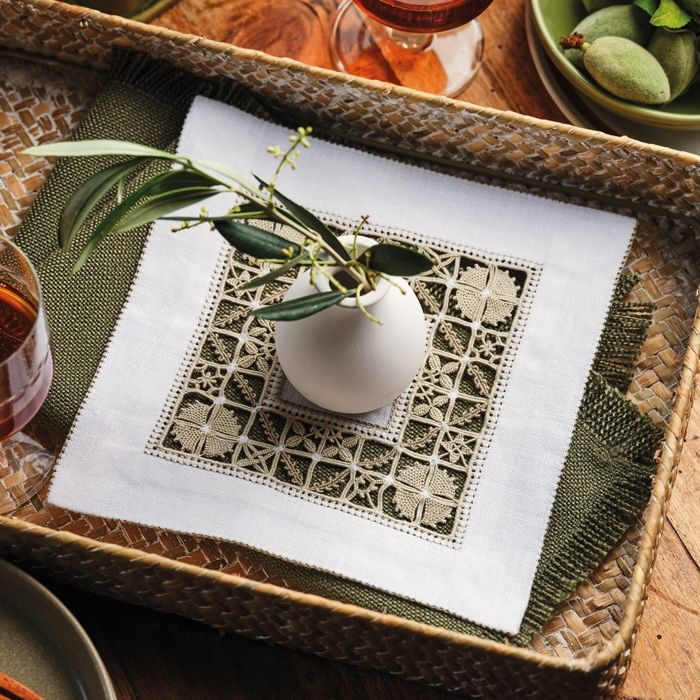
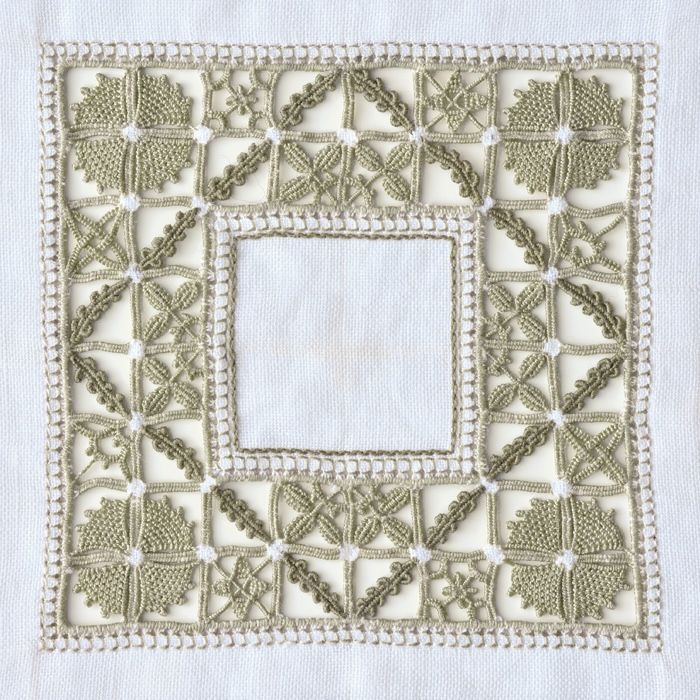
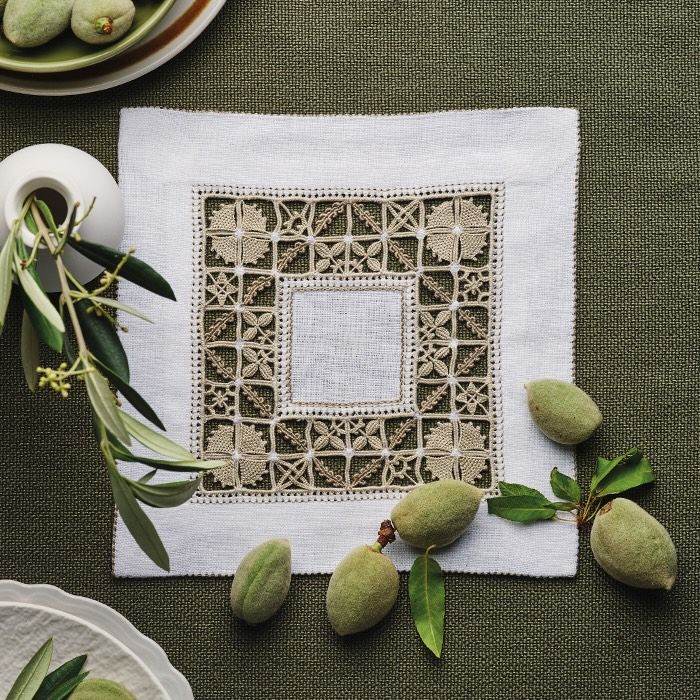
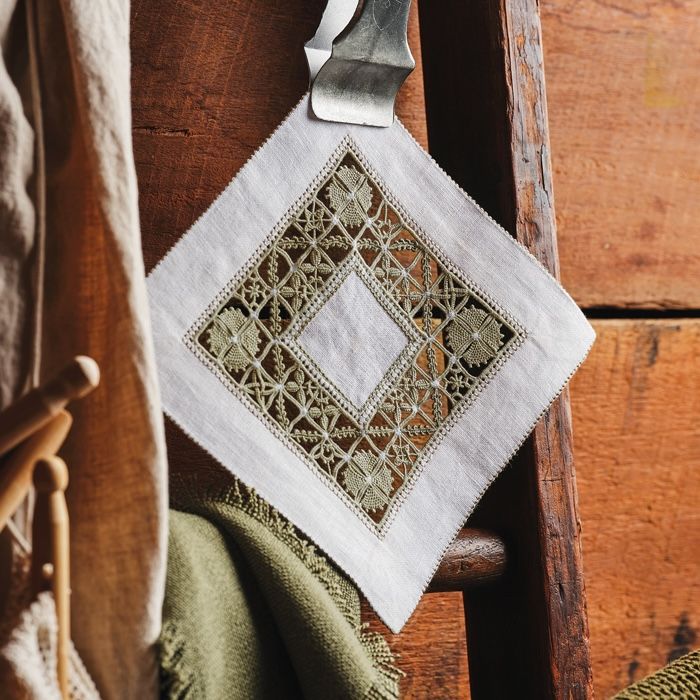
Fumie Suzuki's latest project, Trellis from Inspirations issue #131, is immediately recognisable as reticella.Fumie Suzuki's latest project, Trellis from Inspirations issue #131, is immediately recognisable as reticella.
Threads are withdrawn from a white linen ground to create the grid, the remaining bars are overcast, and the open cells are filled with floral motifs and tiny leaves arranged in a quartered symmetry around a central linen square. The structure is entirely faithful to the tradition.
The stitches follow suit. Detached blanket stitch - the modern cousin of the buttonhole stitch that has been reticella's workhorse for five centuries - is central to the piece, along with its corded variant.
Needleweaving, overcasting, and four-sided stitch are all squarely within the historical vocabulary. Cable stitch, double stem stitch, and antique hem stitch round out the repertoire.
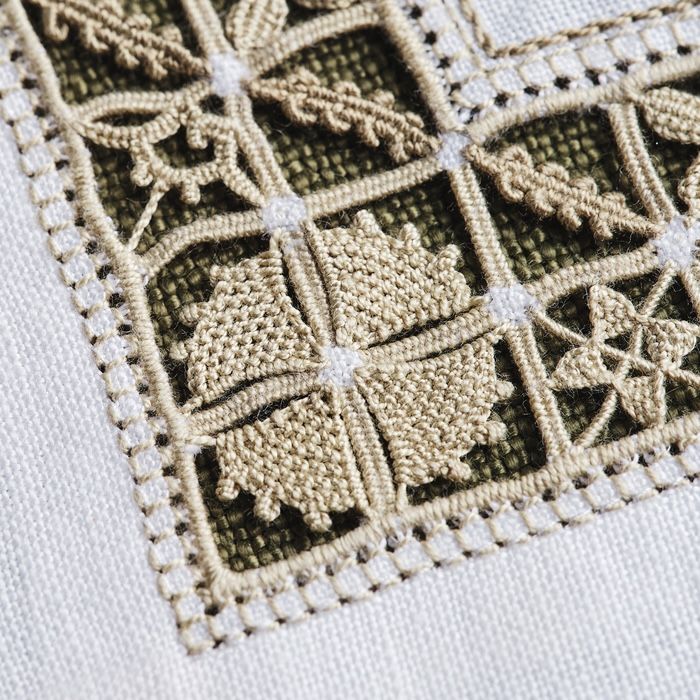
The fabric is traditional in spirit: white linen, as it has always been. The specification - 38-count evenweave - is a modern precision, but the underlying principle is unchanged.
Where Trellis makes its most deliberate departure is the thread colour.Where Trellis makes its most deliberate departure is the thread colour.
Traditional reticella was worked in white linen thread - always. Fumie works in perlé cotton in shades of beige-grey, and the effect is quietly striking.
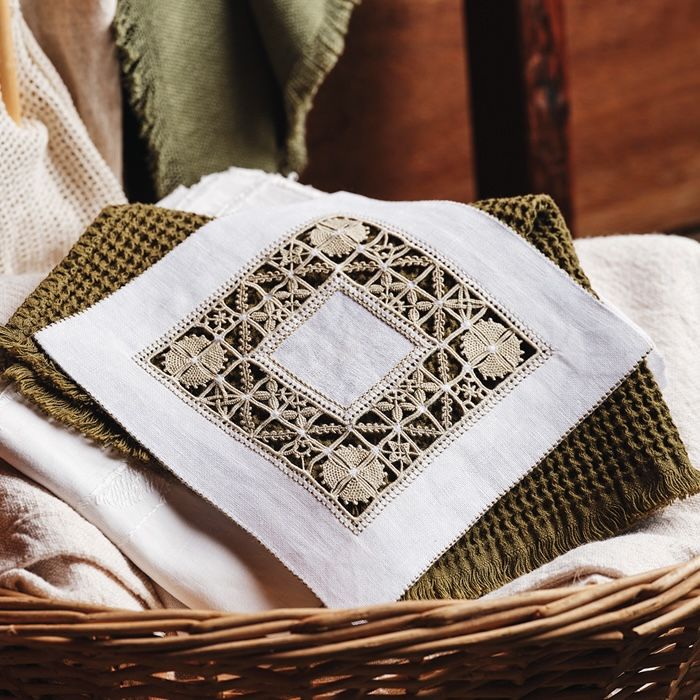
Against white linen, those warm neutral tones give the piece a depth and softness that pure white-on-white doesn't have. The motifs read more clearly. The grid recedes. It's a modern sensibility applied to an ancient technique - and we think it works beautifully.
